Why Every Website Needs Google Analytics Before a Redesign

VIVEK S.L · July 1, 2026

Design decisions should be based on evidence, not assumptions.
It’s common for businesses to redesign their websites because they believe the interface feels outdated or conversions are declining. However, without understanding how users actually interact with the website, even the most beautiful redesign can fail.
This is where Google Analytics becomes one of the most valuable tools for designers, marketers, and business owners.
What Is Google Analytics?
Google Analytics helps businesses understand how visitors discover, navigate, and interact with their websites.
Instead of guessing why users leave or where they struggle, Analytics provides measurable data about user behavior.
Some of the questions it can answer include:
- Where are visitors coming from?
- Which pages receive the most traffic?
- How long do users stay?
- Which pages have the highest exit rates?
- What devices do visitors use?
- Which marketing channels generate conversions?
These insights create a foundation for better design decisions.
Why Designers Should Care
A website is only successful if it helps users accomplish their goals.
Without behavioral data, designers often rely on opinions from stakeholders or personal preferences.
Analytics shifts the conversation from:
“I think users prefer this layout.”
to
“The data shows users abandon this page after eight seconds.”
That difference changes everything.
Identifying UX Problems
Google Analytics can uncover friction that isn’t immediately visible.
For example:
High Bounce Rate
If users leave shortly after landing on a page, it may indicate:
- Slow loading times
- Irrelevant content
- Poor first impressions
- Confusing navigation
High Exit Rate
If visitors consistently leave from a specific page, it may suggest:
- Broken user flows
- Weak calls-to-action
- Missing information
- Technical issues
Low Engagement Time
When users spend very little time on important pages, the content may not be meeting their expectations.
Analytics helps identify where to investigate—not necessarily why. Combining data with usability testing often reveals the complete picture.
Measuring Conversions
One of the biggest advantages of Google Analytics is tracking conversions.
Depending on the business, conversions might include:
- Purchasing a product
- Submitting a contact form
- Booking a consultation
- Downloading a guide
- Signing up for a newsletter
- Creating an account
Tracking these actions allows teams to understand which pages contribute to business goals and which ones need improvement.
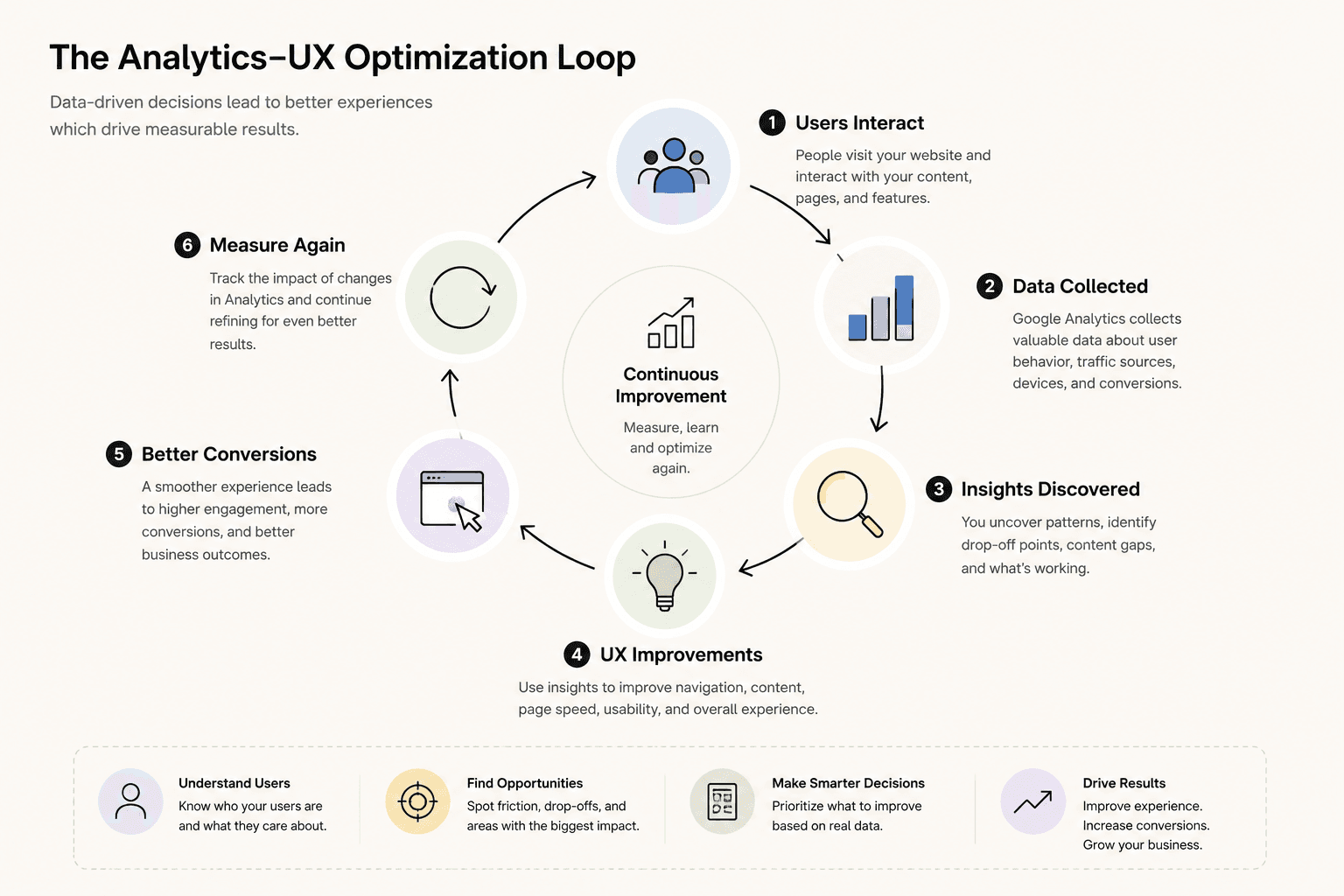
Turning Data Into Better Design
Analytics should influence every stage of the design process.
A simple workflow looks like this:
Collect Data → Identify Problems → Form a Hypothesis → Design a Solution → Test → Measure Again
This cycle transforms design from subjective decision-making into continuous improvement.
Metrics Worth Monitoring
Some of the most valuable metrics include:
Users & Sessions — Understand website traffic
Traffic Sources — Identify where visitors come from
Engagement Time — Measure content effectiveness
Bounce Rate — Detect potential friction
Exit Pages — Find where users abandon journeys
Conversion Rate — Measure business success
Events — Track user interactions like clicks, downloads, and video plays
Looking at these metrics together provides a clearer picture than relying on a single number.
Analytics Is Only Half the Story
Data explains what users are doing.
It rarely explains why.
For deeper insights, Google Analytics should be combined with tools such as heatmaps, session recordings, usability testing, and user interviews.
When quantitative and qualitative research work together, teams make more informed product decisions.
Final Thoughts
Every website generates valuable data. The difference between successful businesses and struggling ones is whether they use that data to improve.
Google Analytics is more than a reporting tool—it is a decision-making tool. It helps teams understand user behaviour, identify friction, validate design decisions, and measure business impact.
Before redesigning a website, launch a new feature, or change a conversion funnel, start by understanding what your users are already telling you through their behaviour.