The Hidden Cost of Poor User Experience

VIVEK S.L · June 29, 2026

Most users will never tell you that your product is difficult to use.
They won't send detailed feedback. They won't explain where they got confused. In most cases, they will simply leave.
Poor user experience rarely fails dramatically. Instead, it fails quietly—through abandoned sign-ups, incomplete purchases, and declining engagement.
Every Click Has a Cost
Each interaction in a product demands effort from the user. Filling forms, navigating menus, remembering information, and making decisions all consume mental energy.
When this effort becomes too high, users experience friction.
Common sources of friction include:
- Unclear navigation
- Inconsistent interfaces
- Excessive form fields
- Poor error handling
- Slow loading times
- Ambiguous calls-to-action
Even small frustrations can compound over time.
Simplicity Is a Competitive Advantage
Products that feel intuitive create trust.
Users prefer experiences that allow them to accomplish tasks quickly and confidently. They do not want to learn your interface—they want to achieve their goals.
Consider the difference between these two experiences:
Experience A
- Create an account
- Verify email
- Complete profile
- Configure settings
- Start using the product
Experience B
- Sign in with Google
- Start immediately
The second experience removes barriers and delivers value faster.
Designing for Clarity
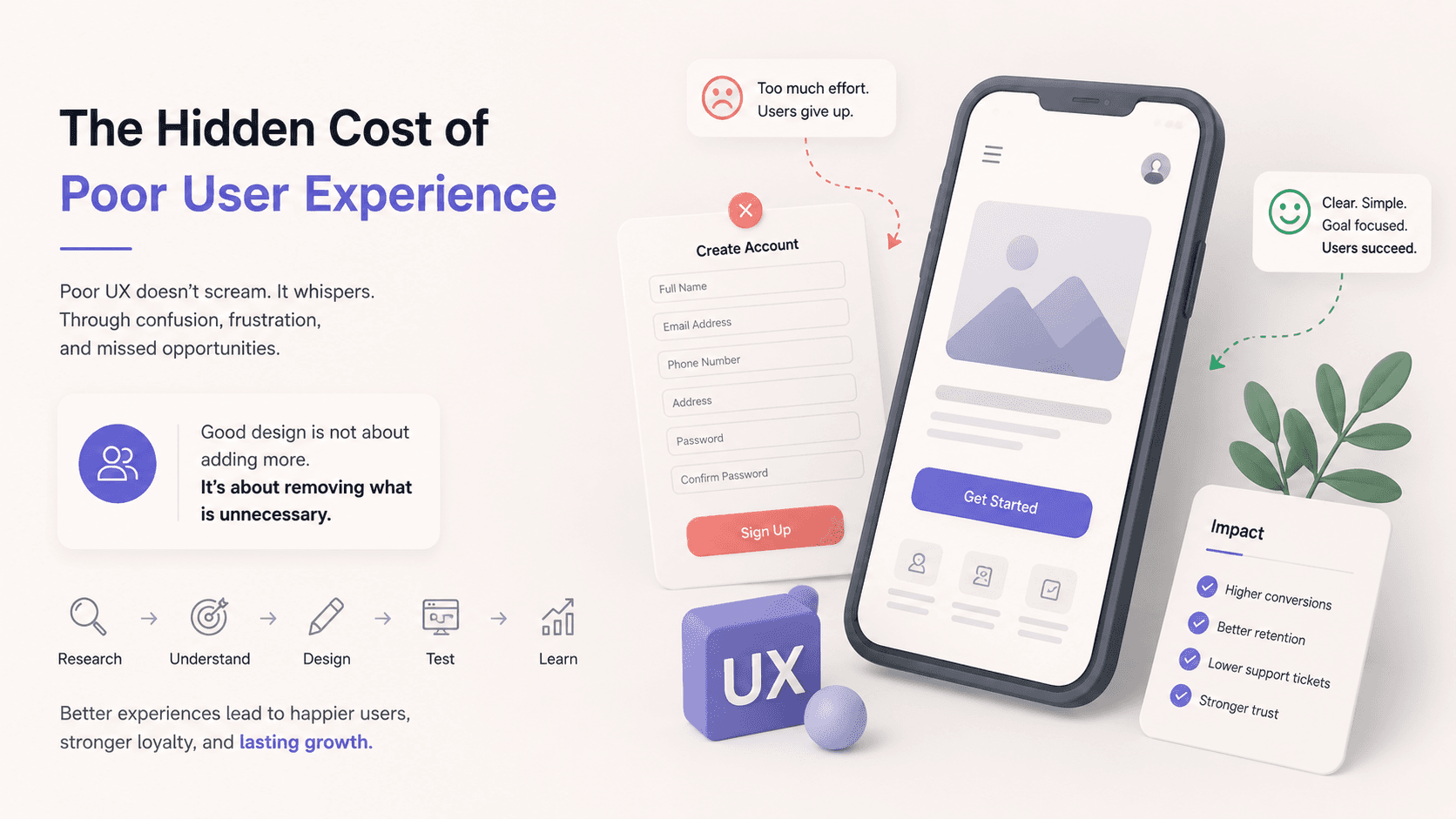
Clarity should guide every design decision.
Ask yourself:
- Does this element help users achieve their goal?
- Can this process be simplified?
- Is this information necessary right now?
- Can users recover easily from mistakes?
If the answer is no, reconsider the design.
Good design is not about adding more. It is about removing what is unnecessary.
The Role of Research
Design assumptions are dangerous.
Research helps teams understand:
- User motivations
- Pain points
- Behavioral patterns
- Context of use
- Accessibility needs
Methods such as interviews, usability testing, analytics, and surveys provide valuable insights that reduce uncertainty.
Observe → Understand → Design → Test → Learn
This cycle should continue throughout the product's lifecycle.
Measuring UX Success
Design decisions should be evaluated against measurable outcomes.
Important metrics include:
Metric
What It Indicates
Conversion Rate
Ability to drive action
Task Success Rate
Ease of completing tasks
Retention
Long-term product value
Error Rate
Areas of confusion
Customer Satisfaction
Overall experience quality
Data reveals what is happening. Research reveals why.
Final Thoughts
Users compare every digital experience against the best products they use daily. Expectations continue to rise.
Organizations that invest in user experience are not merely improving interfaces—they are improving business outcomes, customer loyalty, and long-term growth.