Building a Customer Experience Roadmap From the Ground Up: The Complete Guide

VIVEK S.L · July 5, 2026

Most businesses genuinely care about their customers. Yet caring is not a strategy. Without a structured plan that connects customer pain points to real business actions, even the most well-intentioned CX programs end up going in circles — burning resources without moving the needle.
That's precisely the problem a customer experience roadmap is built to fix.
Whether your goal is to cut churn, strengthen retention, or transform your business into one that customers actively advocate for, a CX roadmap gives you the operational clarity to make it happen. This guide walks you through every step of building one from scratch, covering frameworks, components, metrics, and the common pitfalls that derail most teams before they get started.

What Exactly Is a Customer Experience Roadmap?
A customer experience roadmap is a prioritized, time-bound action plan that outlines how your business will systematically improve the experience it delivers to customers. It bridges the gap between customer insights and business execution — turning research, feedback, and journey data into a concrete sequence of improvements tied to measurable outcomes.
Think of it as your answer to three deceptively simple questions:
- Where are customers struggling the most?
- Which problems should we solve first?
- How do we know when we've actually improved things?
In organizations that operate with CX maturity, the roadmap becomes a shared reference point across product, design, marketing, and customer support — a single source of truth that eliminates the ambiguity of "whose job is it to fix this?"
The business case is hard to ignore: 65% of customers have reduced their spending with companies that failed to meet their experience expectations. A well-structured CX roadmap is not just a planning exercise — it directly protects and grows revenue.
Customer Experience Roadmap vs. Customer Journey Map vs. CX Strategy
These three terms get conflated constantly, but they serve fundamentally different purposes. Understanding the distinction is essential before you start building.
CX Strategy operates at the highest altitude. It defines your brand's vision for customer experience and articulates how that vision connects to business growth. It is directional and principle-driven — but it does not tell you what to build or when.
Customer Journey Maps are diagnostic tools. They visualize the end-to-end experience a customer has with your brand — mapping touchpoints, emotional highs and lows, friction points, and unmet needs across stages like awareness, onboarding, and support. They tell you what is happening.
CX Roadmaps sit between strategy and execution. They take the insights surfaced by journey maps and align them with strategic priorities, then turn them into a phased, actionable plan. They tell you what to do about it.
The 8 Core Components of an Effective CX Roadmap
Research consistently shows that 84% of companies that actively work to improve customer experience report measurable revenue increases. The difference between those that succeed and those that don't often comes down to whether their roadmap includes all the right building blocks.
1. A Clear CX Vision Tied to Business Outcomes
Every roadmap needs a north star. Define what "great customer experience" looks like for your business and connect it to specific, measurable business goals — whether that's reducing churn by 15%, lifting your NPS by 20 points, or improving first-contact resolution rates in support.
2. Grounded Customer Insights
A roadmap built on assumptions will fail. Anchor every initiative in real data: customer surveys, usability research, support ticket analysis, behavioral analytics, and voice-of-customer programs. The more directly your roadmap reflects actual customer frustrations, the more impact it will drive.
3. End-to-End Journey Mapping
A comprehensive view of your customer journey — from first awareness through purchase, onboarding, ongoing use, and support — is non-negotiable. Journey mapping reveals where friction concentrates, where customers drop off, and where expectations aren't being met.
4. Clearly Defined Pain Points and Opportunity Areas
Surface the specific gaps between what customers expect and what they actually experience. Frame these as customer problem statements, not internal assumptions. This keeps the roadmap honest and customer-centric rather than feature-list-driven.
5. Prioritized CX Initiatives
Not everything can be fixed at once. Use a structured prioritization model — typically impact versus effort — to identify quick wins, strategic investments, and items to defer. This is where roadmaps move from wishful thinking to executable plans.
6. A Phased Timeline
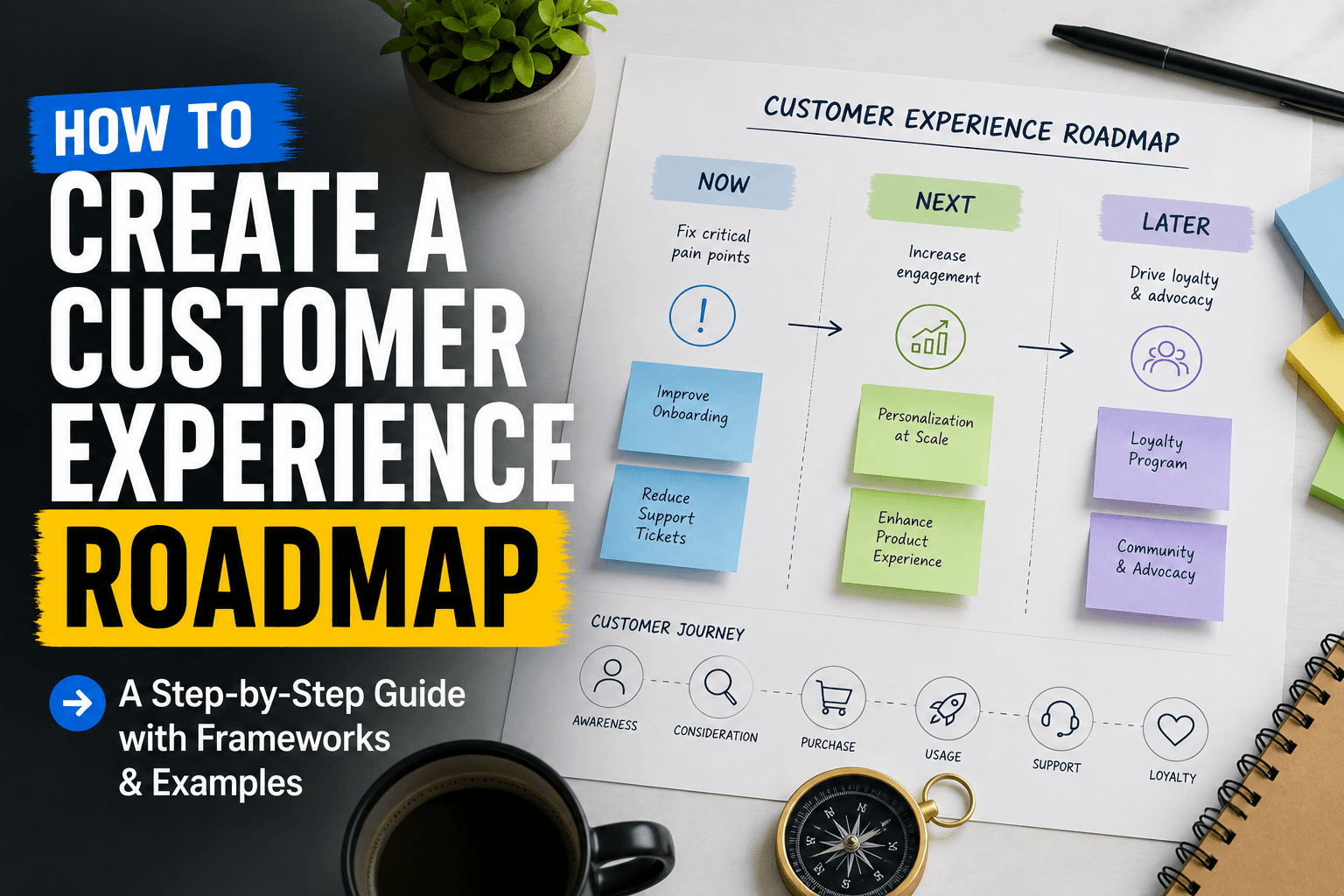
Organize initiatives into clear phases: Now, Next, and Later. This provides teams with immediate clarity on what to act on while keeping future improvements visible and planned rather than ad hoc.
7. Cross-Functional Ownership
Customer experience is not owned by any single team. Your roadmap must assign clear accountability across product, design, engineering, marketing, and support — with each initiative having a named owner and defined dependencies.
8. Success Metrics and KPIs
Every initiative needs a measurable outcome. Tie CX improvements to both experience metrics (NPS, CSAT, CES) and business metrics (retention rate, lifetime value, churn rate). Without measurable goals, the roadmap has no feedback loop.
How to Build a Customer Experience Roadmap from Scratch: 6 Steps
Step 1: Define Your CX Vision and Business Goals
Begin with clarity on what you're trying to achieve. Write down your CX vision — the experience quality you want to be known for — and pair it with two to three specific business objectives. "Reduce 90-day churn by 20%" is actionable. "Improve the customer experience" is not.
This alignment step prevents roadmap sprawl and ensures every initiative you add later has a clear reason for existing.
Step 2: Gather Customer Insights and Map the Journey
Collect data from every source available to you: surveys, NPS responses, usability sessions, in-product behavioral data, support conversations, and churn exit interviews. Layer these insights onto a customer journey map that covers every major stage of the lifecycle.
The goal at this stage is not to find solutions — it is to build an honest, evidence-based picture of what customers are actually experiencing.
Step 3: Identify Pain Points and Frame Opportunity Areas
Analyze your journey map to isolate where the experience breaks down. Look for repeated complaints, support spikes, drop-off patterns, and moments where customer effort is disproportionately high.
Translate findings into clear problem statements: "Customers find the onboarding flow confusing and frequently abandon before completing setup" is a problem statement. "We need better onboarding" is not. Precision here determines how focused your initiatives will be.
Step 4: Prioritize Using an Impact and Effort Framework
List every potential improvement you've identified, then map each one against two dimensions: business and customer impact versus implementation effort.
- High impact, low effort — Prioritize immediately as quick wins
- High impact, high effort — Plan as strategic initiatives
- Low impact — Deprioritize or defer
This step is where many roadmaps go wrong — without a clear prioritization model, everything ends up labeled "high priority" and nothing gets done well.
Step 5: Define Metrics and Organize Into Phases
Assign KPIs to every initiative before building the timeline. This discipline forces your team to think about why each item belongs on the roadmap, not just what it is.
Then structure the roadmap into three phases:
- Now: Initiatives launching within the current quarter
- Next: Initiatives planned for the following one to two quarters
- Later: Longer-horizon improvements that depend on earlier phases
A phased structure keeps execution realistic and prevents teams from being overwhelmed by the full scope of CX improvements.
Step 6: Align Teams, Execute, and Continuously Iterate
Socialize the roadmap across all relevant teams and leadership. Assign owners. Set review cadences. Most importantly, treat the roadmap as a living document — not a static deliverable that gets filed away after the kick-off meeting.
Schedule regular reviews to assess initiative outcomes, incorporate new customer data, and reprioritize as you learn. The organizations that derive the most value from CX roadmaps treat them as ongoing systems, not one-time projects.
Four CX Roadmap Frameworks Worth Knowing
1. Now–Next–Later Framework
The most widely used CX roadmap structure. It organizes initiatives into three time-based buckets — immediate, mid-term, and future — without committing to rigid dates. It is highly effective for teams that need flexibility while maintaining clear prioritization.
2. Opportunity Solution Tree
A structured approach that starts with desired customer outcomes, maps the specific opportunities (unmet needs or pain points) that affect those outcomes, and then explores multiple solutions before committing to any. It keeps the roadmap rooted in real problems and encourages creative solution-finding before locking in execution paths.
3. Agile CX Roadmap
Designed for fast-moving organizations where customer needs and business priorities shift frequently. Instead of long fixed plans, the agile CX roadmap operates in short execution cycles, with continuous feedback loops and regular reprioritization based on live performance data.
4. Outcome-Driven Roadmapping
Flips the typical planning process: instead of starting with a list of improvements, teams define the specific outcomes they need to achieve — for example, "reduce onboarding drop-off by 25%" — and then work backwards to identify which initiatives have the highest probability of reaching that outcome. This produces roadmaps that are inherently results-oriented rather than output-focused.
Common Challenges — and How to Overcome Them
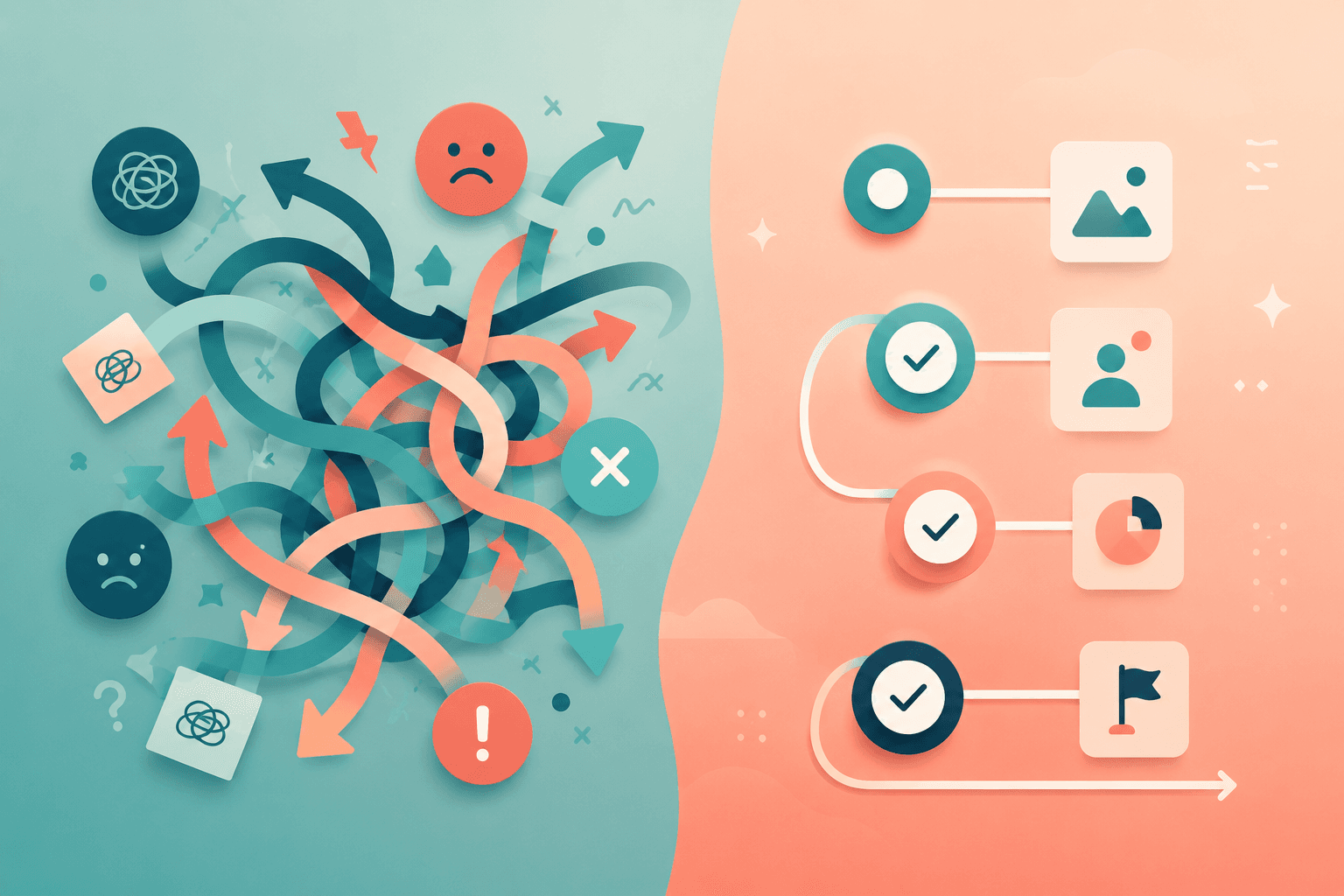
Gartner projects that 80% of companies will compete primarily on customer experience. Yet most struggle to turn CX ambition into consistent execution. These are the most common breakdowns — and what to do about them.
Challenge: No reliable customer data
Roadmaps built on gut instinct rather than real evidence inevitably prioritize the wrong things. Fix this by establishing continuous feedback loops and consolidating insight from behavioral data, surveys, and support interactions into a single view of the customer.
Challenge: Team misalignment
When product, marketing, and support teams each have separate CX priorities, the customer ends up experiencing a fragmented journey. Solve this by using the roadmap as a shared alignment artifact — one that every stakeholder has contributed to and is accountable for executing.
Challenge: Overloaded roadmaps
Trying to fix everything at once is the surest way to fix nothing. Apply a rigorous prioritization framework and limit each phase to a manageable number of initiatives. Focused execution beats comprehensive inaction every time.
Challenge: Resistance to change
Stalled execution is often a people problem, not a planning problem. Involve key stakeholders early in the process, communicate the business case clearly, and use early quick wins to build organizational confidence that the roadmap actually works.
Metrics and KPIs for Measuring CX Roadmap Success
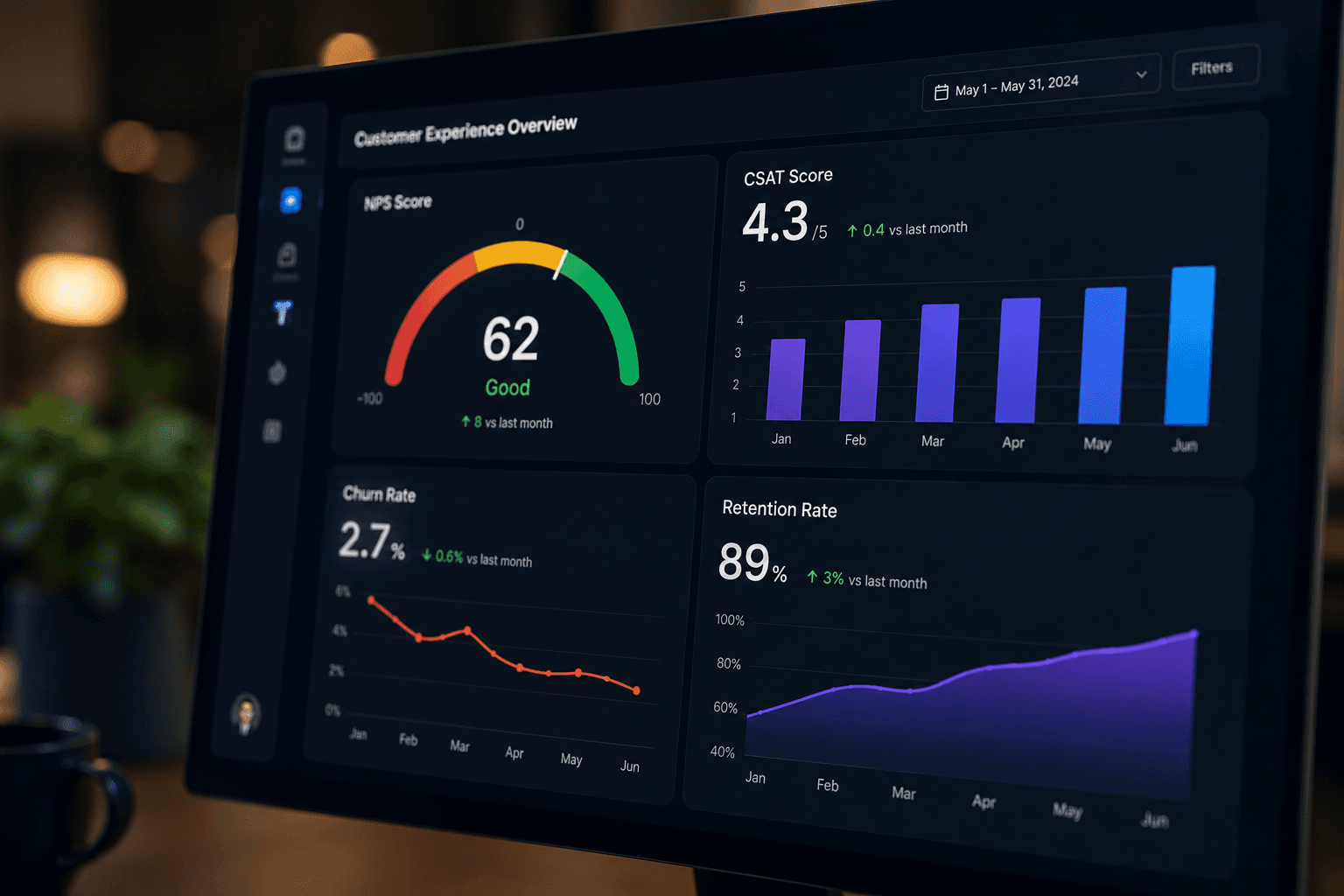
Measurement is not optional — it is what separates a CX roadmap from a wish list. Consider this: 87% of customers who have an excellent experience are likely to make another purchase, compared to just 18% who had a very poor experience. The ROI of great CX is not abstract. It shows up in your numbers.
Core Experience Metrics
Net Promoter Score (NPS): Measures customer loyalty and the likelihood of recommendation. A leading indicator of retention and brand growth.
Customer Satisfaction Score (CSAT): Captures satisfaction at specific touchpoints — particularly useful after high-stakes interactions like support resolutions or purchase completions.
Customer Effort Score (CES): Measures how easy it is for customers to accomplish something. Reducing friction is one of the highest-leverage levers in CX improvement.
Business Performance Metrics
Retention Rate: Directly reflects whether CX improvements are translating into customers choosing to stay.
Customer Lifetime Value (LTV): A sustained improvement in experience typically increases LTV through higher repeat purchase rates and deeper product engagement.
Churn Rate: A lagging but crucial indicator of whether experience gaps are causing customers to leave.